


Ontario Employers Hiring in the Baltics:Employment Law Differences in Lithuania, Latvia and Estonia

Ontario businesses that open an office, acquire a company or hire remote employees in the Baltic region will encounter familiar employment-law concepts—but very different formalities. A contract or dismissal process that works in Ontario may not satisfy the mandatory rules of Lithuania, Latvia or Estonia.
Updated July 2026 | General legal information, not legal advice
Guest Post from Our Guest Writer
Publisher-facing angle: This article uses Ontario employment law as the reference point and compares it directly with the rules that apply in Lithuania, Latvia and Estonia. The Baltic content remains central, but the practical question is now clear: what must an Ontario employer change before hiring in the Baltics? Disclaimer: The Writer is NOT an expert in Ontario law, and it's just a comparative analysis of Ontario law to Baltic nations. It is NOT to be construed as legal advice in Ontario. Click here to contact HTW Law - Employment Lawyer for assistance and legal consultation. |

Why Ontario Is a Useful Starting Point—but Not a Template

For an Ontario employer, the Baltic states can look deceptively familiar. All four jurisdictions regulate working time, overtime, probation, fixed-term employment and dismissal. The risk is assuming that similar labels produce similar legal outcomes.
Ontario employment law is built around statutory minimum standards under the Employment Standards Act, 2000 (ESA), together with contractual rights, common-law principles and other legislation. The Baltic states use more heavily codified systems shaped by national labour codes and European Union law. In practice, this often means more detailed onboarding documents, prescribed language and registration steps, and stricter rules about how notices are prepared and delivered.
The comparison matters most when an Ontario company hires directly in the Baltics, transfers employees after an acquisition, uses remote or hybrid arrangements, or relies on independent contractors who may legally be employees.
The Ontario Baseline
Before comparing the Baltic jurisdictions, it helps to identify the Ontario assumptions that employers commonly carry into an international expansion.
Employment contracts: The Ontario ESA does not generally require an individual employment contract to be in writing. However, as of July 1, 2025, Ontario employers with 25 or more employees must provide specified job information in writing to a new employee before the first day of work, or as soon afterwards as reasonably possible.
Hours and overtime: For most Ontario employees, the daily limit is eight hours or the established regular workday, the weekly limit is 48 hours unless a written or electronic agreement permits more, and overtime is generally paid at 1.5 times the regular rate after 44 hours in a workweek.
Termination: After three months of continuous employment, the ESA generally requires written notice of termination or termination pay. The statutory individual notice period ranges from one to eight weeks based on service. Separate severance-pay rules may apply, and contractual or common-law rights can exceed the ESA minimums.
Delivery of notice: Ontario termination notice may be delivered in person or by mail, fax or email, provided delivery can be verified. A secure electronic signature is not generally an ESA condition for email delivery.
Probation: Ontario's ESA does not create a universal statutory probationary period. The practical three-month marker comes from the rule that statutory termination notice is generally not owed before three months of continuous employment.
Practical takeaway: Ontario law often supplies minimum entitlements while leaving significant room for contract and common law. In the Baltics, the sequence, form, language and statutory basis of an employer's action are frequently just as important as the commercial decision itself. |
What Ontario Employers Should Expect Across the Baltics
Lithuania, Latvia and Estonia share EU-derived principles, including rules on working time, equal treatment, employee information and cross-border mobility. They should not, however, be treated as one employment-law market.
Local documents matter. An Ontario offer letter should not simply be translated and reused. Mandatory terms, language rules and document-delivery requirements differ by country.
Registration and payroll steps can begin before work starts. Lithuania and Latvia, for example, require employer notifications to local social-security or tax authorities before the employee begins working.
Dismissal is procedural. A valid business reason may still lead to liability if the notice, statutory ground, consultation, delivery method or timing is wrong.
Remote work does not eliminate local law. The employee's habitual place of work, tax and social-security position, health-and-safety duties and data-protection obligations must be assessed together.

Lithuania: A Codified System with Important Procedural Nuance

Lithuania's Labour Code is detailed and formal, but it should not be described as uniformly hostile to employers. Many outcomes depend on the exact statutory ground, the employee's circumstances, the wording of the documents and whether the required procedure was followed.
Written Contract and Pre-Start Registration
An employment contract must be concluded in writing in duplicate. The contract must include the statutory terms, including the job function, remuneration and workplace. It must be prepared in Lithuanian or, for a foreign employee, in Lithuanian and another language understood by the employee.
The employer must notify the territorial office of the State Social Insurance Fund Board (Sodra) about the employment at least one working day before the scheduled start date. The employee should begin work only after being informed of the applicable employment terms, workplace procedures and health-and-safety requirements.
Ontario comparison: Ontario generally does not make the validity of an ordinary employment relationship depend on a duplicate written contract or a pre-start social-insurance registration. In Lithuania, onboarding is a regulated legal process, not merely an HR preference. |

Working Time, Overtime and Contract Changes
The standard full-time schedule is generally 40 hours per week, commonly eight hours per day over five days. Maximum working time, overtime and minimum rest must be assessed against the particular working-time arrangement. Changes to core employment terms or the agreed working-time regime normally require the employee's written consent.
By comparison, Ontario's general overtime threshold is 44 hours per week, while the ordinary weekly hours limit is 48 unless a valid written or electronic agreement permits additional hours. An Ontario payroll or scheduling policy should therefore be rebuilt for Lithuania rather than converted mechanically.
Probation and Termination
A probationary period may be agreed for up to three months. If the employer concludes that the probation result is unsatisfactory, the contract may generally be terminated with three working days' written notice before the probation period ends, without statutory severance.
An employee resigning without a special statutory reason generally gives at least 20 calendar days' written notice. For termination by the employer without employee fault, the usual notice period is one month, or two weeks where the employment relationship has lasted less than one year. Longer protections can apply to certain employees. The employer's decision must be in writing and identify the legal ground, relevant legal provision and termination date.

Ontario comparison: Ontario's ESA generally does not require an employer to state the reason for an ordinary termination, provided the dismissal is not prohibited and required notice or pay is given. Lithuania requires the employer to select and document a lawful statutory route. |
Fixed-Term Employment
Lithuania permits fixed-term employment, but limits successive arrangements. As a general rule, the maximum total duration of successive fixed-term contracts for the same job function is two years, while successive contracts for different job functions may extend to five years. Continuing to work after expiry can convert the relationship into open-ended employment, and longer fixed-term relationships can trigger notice and severance obligations at expiry.
Practical takeaway: For Lithuania, the safest approach is to complete the contract, language, Sodra registration, probation wording and working-time design before the employee starts. Trying to repair missing formalities later can create avoidable disputes. |

Latvia: Contract Language, Fixed-Term Limits and Formal Notice

Latvian employment law combines detailed contract requirements with a structured list of dismissal grounds. Ontario employers should pay particular attention to the official-language rule, probation wording, overtime premiums and the method used to deliver a termination notice.
Written Contract and Language Requirements
Employment contracts must be concluded in writing and in Latvia's official language. If a foreign employee does not have sufficient knowledge of Latvian, the employer must notify the employee in writing about the contract terms in a language the employee understands. The contract should contain the statutory information on the role, remuneration, working time, leave, probation and termination procedures.
The employment relationship must also be registered with the Latvian State Revenue Service through its electronic declaration system before work begins.
Ontario comparison: Ontario does not impose a general rule that private-sector employment contracts be drafted in English or French, and an employment contract need not generally be written under the ESA. Latvia makes language and written disclosure central compliance issues. |
Probation
The ordinary maximum probationary period is three months. A collective agreement concluded with an employee trade union may extend the period beyond three months, but not beyond six months, without reducing the employee's overall protection. Shorter limits apply to shorter fixed-term contracts.
During probation, either party may generally terminate the contract with three days' written notice. The employer is not required to state the cause in the probation notice, although anti-discrimination protections continue to apply.
Ontario comparison: Ontario employers often use a three-month probation clause because ESA notice generally begins after three months. Latvia's probation is an express statutory and contractual mechanism with its own notice rule. |
Overtime and Working-Time Records
Latvian overtime is work performed beyond regular working time and generally requires a written agreement, subject to limited statutory exceptions. The employee is ordinarily entitled to an overtime supplement of at least 100% of the applicable hourly or daily rate—in practical terms, double the base rate for the overtime hours. Paid rest may be used in place of the supplement by agreement, and a qualifying sector-level general agreement may set a lower supplement, but not below the statutory floor applicable to that arrangement.
Ontario comparison: For most Ontario employees, overtime is 1.5 times the regular rate after 44 hours in a week. Applying an Ontario overtime multiplier in Latvia can underpay the employee. |

Fixed-Term Contracts
Latvian employment is presumed to be indefinite. A fixed-term contract should be used only for a temporary reason allowed by law, such as seasonal work, a temporary increase in workload or replacement of an absent employee. The total term, including extensions, generally may not exceed five years. Back-to-back contracts and short breaks can be treated as a single continuous arrangement.
If the legal basis for fixed-term status is missing, or the parties continue the relationship beyond the lawful term, the contract may be treated as indefinite.
Termination Grounds and Electronic Delivery
An employer must rely on a ground permitted by the Labour Law and must notify the employee in writing of the circumstances supporting the termination. Notice periods vary by ground. Employee resignation ordinarily requires one month's written notice unless the contract or collective agreement provides a shorter period.
A termination notice may be sent by email using a secure electronic signature only if electronic delivery is provided for in the employment contract or collective agreement. Statutory rules determine when the email notice is deemed received, and the sender must be able to prove transmission.
Ontario comparison: Ontario's ESA permits termination notice by email if delivery can be verified; it does not generally require a secure electronic signature. A standard Ontario email dismissal process should not be copied into Latvia. |
Practical takeaway: For Latvia, employers should treat the contract language, fixed-term justification, overtime method and delivery clause as core design decisions. These points should be agreed before the first day, not addressed only when a dispute arises. |
Estonia: Digital Processes with Substantive Employment Protections

Estonia is often viewed as the most digitally advanced and operationally flexible Baltic jurisdiction. That flexibility does not make employment law optional. Written records, worker classification, working-time limits and termination reasons remain highly important.
Written Contracts and Worker Classification
An employment contract should be entered into in writing, although failure to comply with the form requirement does not automatically make the relationship void. The written-form requirement generally does not apply where the contract lasts no more than two weeks.
Civil-law service or authorisation agreements may be used only where the individual is genuinely independent. Where the business directs and controls how the work is performed, the relationship may be treated as employment regardless of the label used. Misclassification can create employment, tax and social-security exposure.
Ontario comparison: Ontario also looks at the real relationship rather than the contract label when determining employee status. The practical lesson is the same: contractor templates do not override day-to-day control. |
Probation and Flexible Working-Time Agreements
A four-month probationary period generally applies from the start of work unless the parties agree to remove or shorten it. For a fixed-term contract lasting up to eight months, probation may not exceed half of the contract term.
Estonia introduced a broader flexible working-time agreement regime effective February 13, 2026. A qualifying employer and employee may agree in writing to divide working time into guaranteed agreed hours and additional hours. The agreement must state the agreed hours, the maximum additional hours, the minimum advance-notice period and the employee's right to refuse additional hours. Each instance of additional hours requires the employee's prior confirmation in a form reproducible in writing.
The arrangement is subject to eligibility conditions, including a minimum agreed workload and an hourly wage threshold. Agreed and additional hours combined may not exceed full-time work, and records must distinguish agreed hours, additional hours and overtime.
Ontario comparison: Ontario permits written agreements for excess hours and overtime averaging in defined circumstances, but Estonia's 2026 flexible-hours model has its own eligibility criteria, mandatory contents and consent requirements. |
Termination Formalities and Notice
A cancellation declaration must be made in a form that can be reproduced in writing. The employer must justify the cancellation in that form. An employee must justify an extraordinary cancellation, but not an ordinary resignation.
For employer cancellation, the statutory advance-notice periods generally scale with service: at least 15 calendar days for less than one year, 30 days for one to five years, 60 days for five to ten years and 90 days for ten years or more. An employee's ordinary resignation normally requires at least 30 calendar days' notice. Layoff termination generally also carries compensation equal to one month's average wages.
A fixed-term contract cannot simply be ended early because the employer no longer needs the role. Unless a lawful extraordinary ground exists, early cancellation may expose the employer to compensation tied to the unexpired term.
Ontario comparison: Ontario ESA notice for an individual termination is generally one to eight weeks after three months of service, while common-law rights may be greater. Estonia uses a statutory service-based schedule of up to 90 calendar days and generally requires the employer to justify the cancellation. |
Practical takeaway: Estonia rewards careful documentation and allows modern working structures, but digital convenience should not be confused with light regulation. Written evidence and the actual substance of the relationship remain decisive. |

Ontario vs Lithuania vs Latvia vs Estonia: Practical Comparison
The table is a high-level planning tool. Sector-specific rules, collective agreements, protected employee categories and the facts of a particular termination can change the result.
Issue | Ontario | Lithuania | Latvia | Estonia |
Primary framework | Employment Standards Act, 2000 and regulations; contracts, common law and other statutes may provide greater rights. | Labour Code (Darbo kodeksas), with detailed statutory procedures. | Labour Law (Darba likums), with prescribed contract and termination rules. | Employment Contracts Act (Töölepingu seadus), supported by digital-form rules. |
Written contract | Not generally required by the ESA, but written job information is mandatory for new employees of employers with 25+ employees. | Required in writing in duplicate; Lithuanian or bilingual for a foreign employee. | Required in writing and in Latvian; understandable written information for a foreign employee. | Generally required in writing; lack of form does not automatically void the relationship; short contracts may be exempt. |
Probation | No universal ESA probation period; statutory termination notice generally begins after 3 months. | Up to 3 months; 3 working days' notice for unsuccessful probation. | Usually up to 3 months; up to 6 months under a qualifying union collective agreement; 3 days' notice. | Generally 4 months; may be removed or shortened; 15 days' notice for probation cancellation. |
Ordinary hours / overtime | Generally max 8 hours/day or regular day and 48/week unless agreed; overtime 1.5× after 44 hours/week for most employees. | Full-time generally 40 hours/week; overtime and rest depend on the working-time arrangement. | Full-time generally 40 hours/week; overtime supplement ordinarily at least 100%. | Full-time generally 40 hours/week; separate rules for overtime and 2026 flexible working-time agreements. |
Fixed-term employment | Permitted. ESA notice exemption at natural expiry is conditional and can fail, including for terms beyond 12 months or early termination. | Same-function successive terms generally capped at 2 years; different functions may total up to 5 years. | Allowed only for statutory temporary reasons; generally capped at 5 years including extensions. | Permitted where justified; early cancellation without lawful grounds can trigger compensation. |
Employee resignation | No general ESA notice schedule for ordinary resignation; contract and common-law issues may apply. | Generally 20 calendar days' written notice. | Generally 1 month's written notice unless shortened by contract or collective agreement. | Generally 30 calendar days' notice for ordinary cancellation. |
Employer termination | After 3 months, generally 1–8 weeks' ESA notice or pay; severance and greater common-law rights may apply. | Statutory ground and written decision required; usually 1 month, or 2 weeks for service under 1 year, for no-fault termination. | Statutory ground and written circumstances required; notice varies by ground; email formalities are strict. | Employer must justify cancellation; notice generally 15/30/60/90 days based on service. |
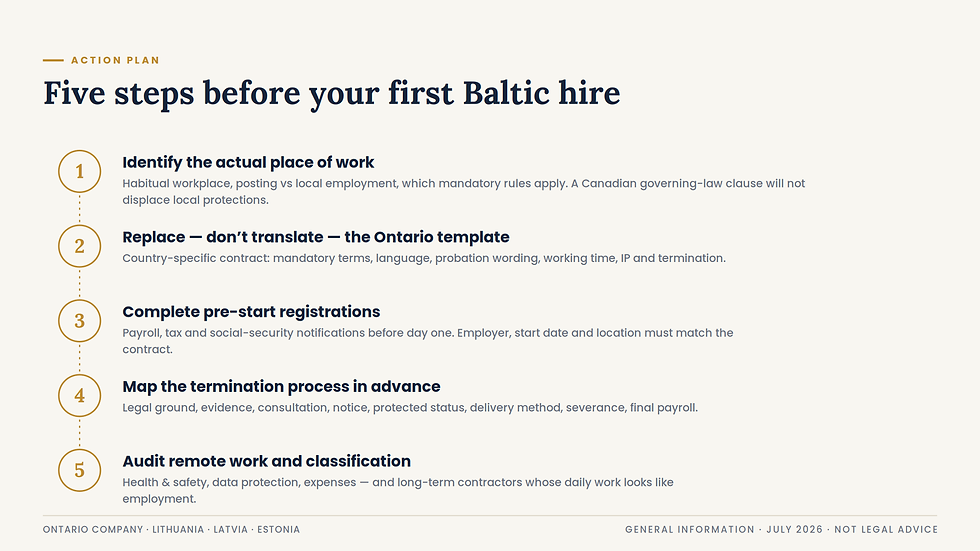
Five Steps for an Ontario Company Before Hiring in the Baltics

1. Identify the actual place of work.
Determine where the employee will habitually work, whether the arrangement involves posting or permanent local employment, and which mandatory rules apply. A Canadian governing-law clause will not necessarily displace local employee protections.
2. Replace—not merely translate—the Ontario template.
Build a country-specific contract that includes local mandatory terms, language requirements, probation wording, working-time rules, confidentiality, intellectual-property and termination provisions.
3. Complete pre-start registrations.
Coordinate payroll, tax and social-security notifications before the first working day. The legal employer, start date and work location must match the contract and registrations.
4. Map the termination process before a problem occurs.
Create a country-specific checklist covering the legal ground, evidence, warnings, consultation, notice period, protected status, delivery method, severance and final payroll.
5. Audit remote work and classification.
Confirm whether remote-work health-and-safety duties, data-protection controls, expense policies and employee-status rules are satisfied. Review long-term contractors whose daily work resembles employment.
Conclusion

Ontario and Baltic employment laws address many of the same workplace issues, but they do so through different legal structures. Ontario employers are accustomed to ESA minimums, contract drafting and common-law risk. Lithuania, Latvia and Estonia place greater emphasis on codified grounds, local-language information, pre-start formalities and the exact form of notices.
An Ontario employment agreement can be a useful checklist of commercial terms. It should not be treated as a Baltic template. The most effective approach is to decide the operating model first, prepare local documents before onboarding and obtain country-specific advice before changing terms or ending employment.
About ECOVIS ProventusLaw
ECOVIS ProventusLaw provides coordinated legal support across Lithuania, Latvia and Estonia and is part of the ECOVIS International network, which operates in more than 90 countries. The firm's employment practice advises local and international employers on contracts, workforce structuring, policies, dismissals, disputes, immigration, data protection and cross-border employment.
The Employment practice is ranked by Chambers Europe 2026 and The Legal 500. Partner Loreta Andziulytė is ranked Band 3 for Employment in Lithuania by Chambers Europe 2026 and has been ranked for four consecutive years.
For a company entering the Baltic market, the value of coordinated advice is consistency: the commercial objective can remain the same while the contract, payroll, working-time and termination process are adapted to each country.
Legal Note and Selected Official Sources
This article provides general information as of July 2026 and is not legal advice. Employment-law outcomes depend on the employee's role, sector, collective agreements, protected status, place of work and the facts of the case. Official English translations of Baltic legislation are provided for convenience; the authentic local-language text prevails.
Employment laws are highly technical and constantly evolving. If you are drafting a contract for a new hire, updating your job postings to comply with 2026 transparency laws, facing a wage dispute, or trying to manage a complex termination, you need specialized legal counsel.
Contact the employment law team at HTW Law today for strategic, up-to-date legal representation tailored to protect you and your business.
If you are an employee, legal issues revolving around employment law could be complicated. Consult with an experienced employment law firm such as HTW Law and secure the equity you’ve earned.

With the right legal support, employees can ensure their employment law rights are protected; employers can avoid lawsuits.
Relevant Blog Posts:

As an employee, you don't have to fight the battle alone. Speaking with an employment lawyer who is familiar with the laws and regulations regarding defamation, discrimination, harassment, wrongful termination, and constructive dismissal, employment contracts and employment law in general will go a long way. If you are in doubt, it's essential that you reach out for help as soon as possible right away.
Click here to contact HTW Law - Employment Lawyer for assistance and legal consultation.


Author bio:
I typed my name too fast when creating this account and just decided to lean into the chaos. Professional over-thinker, amateur nap enthusiast, and 99% sure I left the stove on. I translate complex employment law into plain English by day, and by night, I try to figure out if my own employment contract allows for mandatory nap times.


