


Navigating Workplace Discrimination: Race, Country of Origin, and Immigration in Ontario Employment Law
Updated: Jul 25
In Ontario, the legal architecture governing human rights is anchored by the Ontario Human Rights Code (the "Code"). Section 5 guarantees every person the fundamental right to equal treatment in employment, entirely free from discrimination. Yet, despite decades of robust statutory protection, the landscape of prejudice has simply mutated. The days of overt, "smoking gun" discrimination—the explicit racial slur or the blatantly exclusionary job posting—are largely behind us. Today, discrimination operates in the shadows. It is institutional, intersectional, and buried within seemingly neutral corporate policies.
In this article, we will unpack the complex, expanding matrix of discrimination based on race, country of origin, and immigration status. We will dissect the statutory definitions, analyze the binding appellate case law outlining the legal tests, confront the immense evidentiary hurdles of the Human Rights Tribunal of Ontario (HRTO), and reveal the strategic realities of litigating these claims—from proving unlawful reprisals to quantifying massive, stacked damage awards.
1. Deconstructing the Matrix: Race, Country of Origin, and Immigration Status

To successfully litigate human rights, we must first precisely define the grounds under the Code. In modern employment law, these three distinct grounds frequently intersect, creating compounded vulnerabilities for marginalized workers.
A. Racial Discrimination: The Silent Barrier

The Code deliberately abstains from providing a rigid statutory definition of "race," recognizing it as a social construct historically utilized to categorize and marginalize individuals based on physical appearance and perceived heritage. In the modern workplace, racial discrimination rarely involves overt hostility. Instead, it manifests as subtle microaggressions and systemic discrimination: the unequal application of workplace rules, disproportionate disciplinary scrutiny compared to non-racialized peers, or algorithmically driven proxy discrimination in hiring software.
B. Country of Origin (Place of Origin): The "Canadian Experience" Trap

The Code explicitly protects individuals from discrimination based on being born outside of Canada (where "country of origin" and "place of origin" are treated synonymously). The most pervasive form of constructive discrimination in this category is the requirement for "Canadian experience." For decades, employers utilized a lack of domestic experience as a seemingly neutral mechanism to filter out foreign-trained professionals. The Ontario Human Rights Commission (OHRC) now firmly dictates that a strict requirement for "Canadian experience" constitutes prima facie discrimination. Furthermore, linguistic discrimination—such as penalizing an employee for a foreign accent or demanding flawless, unaccented English when it is not technically required for the role's core duties—is legally recognized as a direct proxy for country of origin discrimination.
C. Immigration Status: The Frontier of Citizenship

Here is a critical legal nuance: "Immigration status" is not currently an explicitly enumerated, standalone word in the Code. However, adjudicators have aggressively utilized the protected grounds of "citizenship" and "place of origin" as potent proxies to shield non-citizens. Precarious immigration status (such as holding a temporary work permit or student visa) is inextricably linked to a worker's vulnerability. This dynamic was explicitly recognized in the HRTO decision Logan v. Ontario (Solicitor General), 2022 HRTO 1004, where the Tribunal ruled that weaponizing the precarious status of migrant farmworkers created immense liability under the intersecting grounds of race and place of origin.
2. The Legal Test: Establishing a Prima Facie Case & Case Law Analysis

Because sophisticated HR departments rarely admit to discriminatory motives, the legal framework relies on a burden-shifting mechanism. To ground a claim, an applicant must initially establish a prima facie case. The traditional three-part test, universally mandated by the Supreme Court of Canada in Moore v. British Columbia (Education), 2012 SCC 61, requires you to demonstrate that:
You possess a protected characteristic: Examples include race, place of origin, or citizenship. (It is worth noting that while "immigration status" isn't explicitly listed in the Code, cases like Logan v. Ontario, 2022 HRTO 1004 establish that adjudicators will aggressively use "place of origin" and "citizenship" as proxies to protect workers from discrimination based on precarious immigration status).
You experienced an adverse impact in employment: This could be a revoked job offer, termination, or unequal pay.
The protected characteristic was a "factor" in the adverse impact.
A foundational lesson —and a reality from the Moore decision that constantly trips up employers—is that an "intent to discriminate" is entirely legally irrelevant. The law only cares about the discriminatory effects of a policy or action.
The Race Precedent: Peel Law Association v. Pieters, 2013 ONCA 396

The Ontario Court of Appeal cemented the modern standard for proving racial bias in Pieters. When Black lawyers were aggressively ID-checked in a lawyers' lounge while non-racialized individuals were ignored, lower courts mistakenly demanded a strict "causal link" to prove racism. The Court of Appeal emphatically overturned this, ruling that demanding a strict causal link improperly reverts focus to the discriminator's intent. By legally recognizing unconscious bias and racial profiling as "sociological facts," the Court established that direct evidence of racism is almost never required. Race need only be a factor, not the primary cause.
The Immigration Status Precedent: Imperial Oil v. Haseeb, 2023 ONCA 364

How does Ontario law protect immigration status? Look to the landmark Ontario Court of Appeal decision in Haseeb. An international engineering student was legally entitled to work full-time in Canada under a Post-Graduation Work Permit (PGWP). Imperial Oil revoked his lucrative job offer because its corporate policy strictly required candidates to have "permanent eligibility to work in Canada" (i.e., PR status or citizenship).
The Court of Appeal delivered a sweeping victory for human rights, ruling that this policy constituted illegal discrimination based on citizenship. The Court established a definitive standard: an employer cannot require an individual to hold Canadian citizenship or permanent residency as a pre-condition for employment if that individual possesses alternative legal authorization to work in Canada.
3. The Trenches of Litigation: Evidentiary Hurdles and Tactical Realities

Here is where academic theory meets the trench warfare of litigation. Let’s address the elephant in the room from a savvy litigator's perspective.
Because the HRTO does not charge filing fees, the barrier to entry is virtually non-existent. From a defense and litigation standpoint, a blunt tactical reality has emerged in modern employment law: when facing legitimate performance management or a termination for cause, there is an overwhelming temptation for employees to invoke discrimination. Frankly, because basically everyone who is not a white, Canadian-born citizen possesses a protected characteristic under the Code, we see these claims raised constantly. Race, country of origin, and immigration status are frequently invoked as a tactical shield to save a job, halt a disciplinary process, or leverage a higher severance package.
The Evidentiary Paradox and the "Subtle Scent"
Because of the sheer volume of these tactical claims, HRTO adjudicators have grown inherently skeptical. To separate genuine victims of subtle racism from unmeritorious filings by disgruntled poor performers, adjudicators rigorously look for the "subtle scent of discrimination". However, while frequently conflated in modern litigation, this defining metaphor actually originated in the hallmark federal tribunal decision Basi v. Canadian National Railway, 1988 CanLII 108 (CHRT).
To actually prove that this subtle scent exists, the legal framework relies heavily on the evidentiary standard cemented by the Ontario Court of Appeal in R. v. Brown, 2003 CanLII 52142 (ON CA). In Brown, a landmark case concerning police racial profiling, the Court formally recognized the reality that direct evidence of racism is almost never available because decision-makers rarely confess to their biases. Applying this precedent to employment law, an intent to discriminate can be inferred from the surrounding circumstances. To prove your case, you must build a narrative strictly through circumstantial evidence: statistical disparities in promotion rates, sudden and unexplained deviations from progressive discipline policies applied only to immigrant workers, or a meticulously documented timeline of uninvestigated microaggressions.

The Procedural Guillotine: Rule 19A Summary Dismissals
To weed out baseless, tactical claims, employers aggressively invoke Rule 19A of the HRTO Rules of Procedure to summarily dismiss applications that have "no reasonable prospect of success." As established in leading jurisprudence like Forde v. Elementary Teachers' Federation of Ontario, 2011 HRTO 1389 (CanLII), an applicant's mere subjective belief, feeling, or suspicion of racism—no matter how genuinely held—is legally insufficient to survive a summary hearing. If you cannot point to specific, objective, circumstantial evidence connecting the adverse treatment to your protected grounds, your claim will be executed before a trial even begins.
4. Termination in Reprisal: The Section 8 Shield

What happens if an immigrant employee raises an internal complaint to HR about being paid less due to their country of origin, and the employer responds by suddenly terminating them for alleged "restructuring"?
This triggers Section 8 of the Code, which provides an absolute prohibition against reprisals. The legislative intent is clear: without robust anti-retaliation protections, a "chilling effect" would silence vulnerable newcomers and protect harassers. To successfully prove a reprisal, the HRTO relies on the definitive three-part test established in Noble v. York University, 2010 HRTO 878 (CanLII):
An action was taken against the applicant (e.g., firing, demotion, stripping of shifts).
The action was related to the applicant having claimed, or attempted to enforce, a Code right.
The employer intended to retaliate.
Unlike the test for discrimination (where intent is irrelevant), a reprisal claim strictly requires intent. Adjudicators routinely infer this intent from the "temporal nexus"—the highly suspicious timing between an employee raising a complaint about bias and their sudden termination.
The Ultimate Shield for Genuinely Held Beliefs

Here is a profound legal nuance that terrifies corporate HR departments: an employee does not need to be factually correct about the underlying discrimination to be completely shielded from retaliation.
In Bertrand v. Primary Response, 2010 HRTO 186, an employee falsely alleged his supervisor used a racial slur, and the employer fired him for making the false accusation. The HRTO dismissed the racism claim entirely due to lack of evidence, but ruled the termination itself was an illegal reprisal. As long as an applicant holds a genuinely held, bona fide belief that discrimination occurred, terminating them simply for raising the issue exposes the employer to immense liability.
5. The Remedial Paradigm: Quantifying Damages

Historically, human rights damages in Canada were appallingly low—essentially operating as a trivial "license fee to discriminate." Today, the financial landscape has shifted seismically.
HRTO Uncapped Liability:
Under Section 45.2 of the Code, the HRTO possesses broad, uncapped remedial powers for injury to dignity, feelings, and self-respect. The landmark case of O.P.T. v. Presteve Foods Ltd., 2015 HRTO 675 (CanLII) set a benchmark with a massive award (totaling nearly $200,000 across multiple applicants) solely for injury to dignity. In the Haseeb saga, specifically the remedy decision Haseeb v. Imperial Oil Limited, 2019 HRTO 1174 (CanLII), the employer was ordered to pay approximately $120,000 in combined damages for lost wages and injury to dignity stemming directly from their discriminatory citizenship screening policy.

Civil Courts & "Stacking" Damages:
For high-earning professionals or vulnerable workers forced out of toxic environments, litigating in the Ontario Superior Court of Justice often offers the ultimate strategic advantage. Under Section 46.1 of the Code, civil courts can award human rights damages directly if coupled with an independent civil wrong.
If an employer's systemic racism, harassment, or refusal to acknowledge foreign credentials creates a poisoned work environment that forces you to resign, we sue for Constructive Dismissal. We then execute a strategy of "stacking" damages:
Common Law Notice: Up to 24 months of full severance compensation. This often involves invalidating restrictive employer termination clauses using the Waksdale doctrine, established in Waksdale v. Swegon North America Inc., 2020 ONCA 391 (CanLII).
Human Rights Damages: For injury to dignity, feelings, and self-respect under the Code.
Aggravated/Punitive Damages: Imposed if the employer failed their positive legal duty to investigate your complaints objectively or acted in bad faith during the termination process.
When combined, this stacked quantum transforms discriminatory conduct from an operational nuisance into an existential financial threat for non-compliant organizations.
Leading Case Law on Employer Bad Faith:
Humphrey v. Mene Inc., 2021 ONSC 2539 (affirmed in 2022 ONCA 531) (CanLII): The court awarded the plaintiff $50,000 in aggravated damages and $25,000 in punitive damages. The employer engaged in harsh, disingenuous tactics—including suspending the plaintiff and communicating the suspension to clients and staff to falsely imply misconduct—in a bad-faith attempt to build up a bogus "just cause" termination. The court ruled this toxic conduct repudiated the employment contract.
Colistro v. Tbaytel, 2019 ONCA 197 (CanLII): The Ontario Court of Appeal upheld a massive $100,000 moral (Honda) damages award alongside a finding of constructive dismissal. In this case, the employer's management made the brazen decision to rehire a manager who had sexually harassed the plaintiff 11 years prior. The court found that blatantly disregarding the plaintiff's psychological safety and re-poisoning the workplace justified immense financial penalties.
6. Procedural Mechanics: How to File an HRTO Claim

Initiating a claim at the HRTO requires exact adherence to procedural machinery:
The Strict Limitation Period: You have exactly one year from the date of the discriminatory incident (or the last event in a continuous series) to file. Missing this deadline is generally fatal to your claim.
Filing Form 1: You must complete a Form 1 Application. The HRTO mandates strict technological compliance—you must download the form and open it specifically with Adobe Acrobat Reader (browser viewers will corrupt the file). Your narrative must be exhaustively detailed with circumstantial facts to establish the "subtle scent" of bias and survive a Rule 19A summary dismissal.
Tribunal Service: Unlike civil court, the HRTO assumes the responsibility of formally serving the accepted Form 1 on the employer, who then has roughly 35 days to file a Response (Rule 8.1 of the HRTO Rules of Procedure).
Mandatory Mediation: As of recent procedural shifts for applications filed on or after June 1, 2025, the HRTO heavily integrates mandatory mediation. A neutral adjudicator will attempt to broker a confidential settlement before exposing both parties to the immense evidentiary risks and emotional toll of a full merits hearing.
Relevant Articles of Interest:
7. Conclusion

Discrimination in Ontario is no longer defined strictly by overt hostility; it has evolved into a highly sophisticated, systemic architecture that marginalizes individuals based on the complex intersection of their race, the country they were born in, and the passport they hold. The Ontario Human Rights Code, fortified by unyielding appellate jurisprudence like Pieters and Haseeb, provides a dynamic mechanism designed to combat this concealed reality.
For employees, the legal protections are absolute, particularly regarding severe anti-reprisal shields. However, the evidentiary burdens remain fierce, requiring the strategic assembly of circumstantial evidence to survive aggressive summary dismissals. For employers, the era of relying on "Canadian experience" proxies, demanding permanent residency from legally authorized workers, or ignoring complaints of microaggressions is definitively over. The exponential rise in uncapped human rights damages and stacked civil awards ensures that discriminatory practices now carry unavoidable, devastating financial consequences.
Whether you are an employee whose dignity has been compromised, or an employer requiring sophisticated defense strategies against tactical claims and massive civil liability, navigating this legal minefield requires top-tier representation.
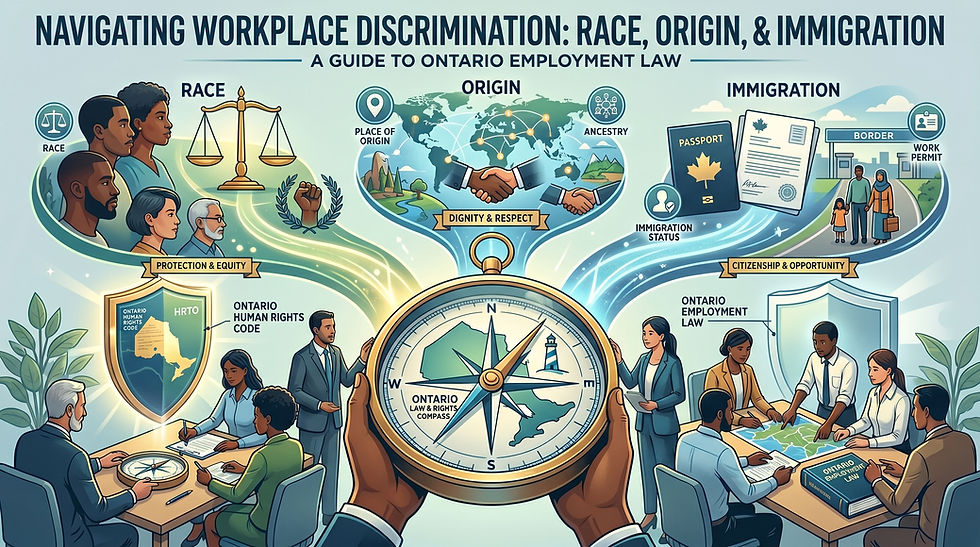
Here is an infographic summarizing how Ontario employment law protects workers against discrimination based on race, place of origin, and immigration status. This guide outlines the key legal frameworks—the Ontario Human Rights Code and the Employment Standards Act—alongside actionable steps and resources for navigating these issues in the workplace: |

Don't fight in the dark. Contact the experienced employment lawyers at HTW Law today to protect your rights, your reputation, and your bottom line.
With the right legal support, employees can ensure their employment law rights are protected; employers can avoid lawsuits. |  |
Relevant Blog Posts:
 | As an employee, you don't have to fight the battle alone. Speaking with an employment lawyer who is familiar with the laws and regulations regarding defamation, discrimination, harassment, wrongful termination, and constructive dismissal, employment contracts and employment law in general will go a long way. If you are in doubt, it's essential that you reach out for help as soon as possible right away. |
Click here to contact HTW Law - Employment Lawyer for assistance and legal consultation.


Author bio:


