


Ontario Pay Transparency Rules 2026: What Job Postings Need

Updated: Jul 25

For years, the phrase "competitive salary" did a lot of quiet work in Ontario job ads. It signalled that pay was negotiable, kept candidates guessing, and let employers settle the number once they knew who they wanted.
As of January 1, 2026, that era is over for a large share of Ontario employers. Ontario's pay transparency rules now require employers with 25 or more employees to include salary or wage information in publicly advertised job postings, disclose AI use in hiring, confirm whether the posting reflects a real vacancy, follow up with interviewed candidates, and expand their record-keeping.
This article breaks down what the law requires, who it covers, where the traps are, and what it means in practice for the way hiring actually happens.
A Guest Post From Our Guest Writer
Relevant Posts of Interest:
What the law actually requires
The rules arrived through the Working for Workers Four and Five Acts and a supporting regulation, amending the Employment Standards Act, 2000. There are several distinct obligations, and most employers focus on the first while missing the rest.
The following job posting and hiring requirements come into force on January 1, 2026:
Working for Workers Four Act, 2024 (Bill 149): Introduced the requirements for salary transparency, AI disclosure, and the ban on Canadian experience requirements.
Working for Workers Five Act, 2024 (Bill 190): Introduced the requirement to confirm whether the job is a real vacancy and the requirement to notify interviewed candidates within 45 days.
The headline requirement is pay disclosure. A publicly advertised posting must include the expected compensation, or a range of compensation, and if a range is used it generally cannot exceed $50,000 – unless the role pays more than $200,000 annually, in which case the requirement does not apply. Crucially, the disclosed figure has to be honest. The range must reflect actual compensation for the role, not an aspirational or misleading figure.
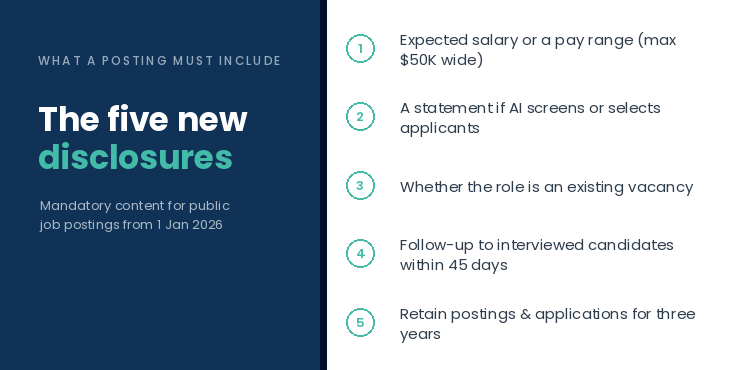
"Compensation" is narrower than people assume. Anything that counts as "wages" under the ESA must be disclosed – base salary or hourly wages, commissions, and guaranteed bonuses – but discretionary bonuses and employer benefit-plan contributions do not need to be included.
Beyond pay, three further obligations apply to covered employers. Employers must disclose whether AI is used to screen, assess, or select candidates; state whether the posting reflects an existing vacancy; notify interviewed candidates of a decision within 45 days; and keep all postings and applications for three years. There's also a prohibition worth flagging for anyone hiring newcomers: employers cannot include Canadian-experience requirements in job postings or application forms.
Who has to comply
The threshold mirrors the familiar 25-employee line, but with an important timing twist. The obligations apply only to an employer with 25 or more employees on the day the job is posted. That is different from the right-to-disconnect rules, which fix the count on January 1. Here the count is assessed each time you publish, so a growing business can cross into coverage mid-year.
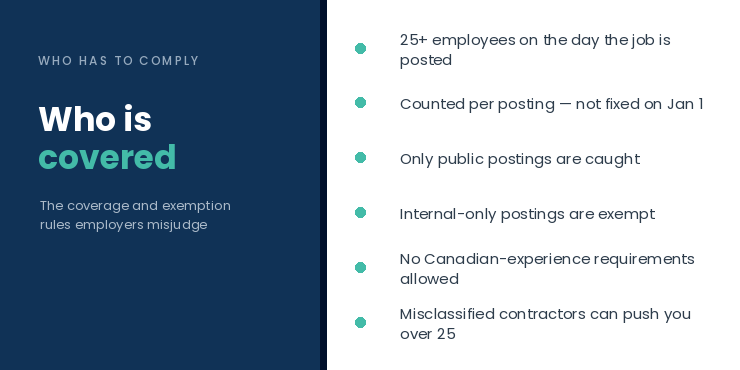
The rules also only bite on public postings. Certain postings are exempt, including internal postings restricted to existing employees, general recruitment campaigns that don't advertise a specific role, and some positions performed entirely outside Ontario. The word of caution from practitioners is that employers over-rely on these exemptions – an "informal" or "exploratory" ad describing a specific role and visible to the public can still be caught.
Where employers get caught out
This is a documentation-and-discipline law, and the failures tend to be operational rather than legal.
A few recurring traps:
Treating the range as a negotiating tactic: A bare "competitive salary" no longer complies, and a range padded out to the full $50,000 width purely to preserve wiggle room invites scrutiny if it doesn't match what current staff actually earn – which can create internal pay-equity friction the moment existing employees see the ad.
Forgetting the AI disclosure: Many employers use résumé-screening or candidate-ranking tools without thinking of them as "AI." The definition is broad, and a generic statement that AI is used in the process is enough to satisfy it – but only if it's actually there.
Miscounting the headcount: Where a business splits staff across related entities or leans heavily on people it labels contractors, the 25-employee count can be wrong. If some of those "contractors" are legally employees, the employer may be over the threshold without realising it – which is why worker classification sits quietly underneath this whole regime.
What it changes in practice
The most interesting effect of the law isn't legal at all – it's behavioural. Transparency forces compensation decisions to the front of the process. Employers can no longer defer the pay conversation until a preferred candidate emerges; they have to settle their own number before the first ad goes live.
That shift is already reshaping hiring behaviour, and it's worth hearing from people who run recruitment processes for a living. According to Sydney-based recruitment agency Ignite – an – the move toward upfront pay disclosure tends to shorten hiring cycles rather than lengthen them, because it filters out candidates whose expectations were never going to align and removes one of the most common reasons offers fall over at the final stage.
The same dynamic is visible in markets like Sydney, where competition for specialised talent is intense and candidates increasingly expect compensation clarity before they'll engage. In other words, the discipline the Ontario rules impose by law is something good recruiters already push employers toward by habit.
For employees and candidates, the practical upside is real but bounded. You'll see a number before you apply, which makes it easier to filter roles and benchmark your worth. But the law has limits worth understanding: it governs the posting, not the offer. An employer who advertises a range is not legally bound to offer you a figure within it once you're hired, and enforcement still depends largely on complaints. Transparency narrows the information gap; it doesn't close it.

How this fits the bigger employment-law picture
Pay transparency doesn't sit in isolation. The figure in a job ad becomes the opening reference point for the employment contract that follows, and getting that contract right – particularly its termination provisions – matters far more to an employer's long-term risk than the posting ever will.
Compensation disclosure also intersects with pay-equity and workplace discrimination obligations: a public range that doesn't match how existing staff are paid can surface disparities an employer would rather not advertise.
And the classification question that lurks under the headcount threshold is the same one that drives much of employment law generally – whether someone is an employee or a contractor changes not just who counts toward 25, but their entitlements on termination, their statutory protections, and the employer's exposure if the line was drawn wrong.
Bottom line
Ontario's pay transparency rules are, like much of the Working for Workers framework, more administrative than revolutionary. They won't force employers to pay more, and they won't guarantee candidates the advertised figure. What they do is end the strategic vagueness that defined Ontario job ads for a generation, pulling compensation decisions forward and putting a number on the table before the conversation starts.
For employers, the smart move is to treat compliance as a prompt to get the underlying pay structure – and the contracts that flow from it – genuinely in order. For candidates, the new transparency is a useful tool, but the posting is only the first document in a much longer chain. If a role's pay, classification, or contract terms don't add up once you're in the door, that's the point at which an Ontario employment lawyer becomes worth a call.
If you're an Ontario employer unsure whether your current policy is compliant – or whether you've crossed the 25-employee threshold without realising it – it's worth getting it reviewed. And if you're an employee feeling pressured to be available around the clock, the policy your employer has on file is often the first document an Ontario employment lawyer will ask to see.
Employment laws are highly technical and constantly evolving. If you are drafting a contract for a new hire, updating your job postings to comply with 2026 transparency laws, facing a wage dispute, or trying to manage a complex termination, you need specialized legal counsel.
Contact the employment law team at HTW Law today for strategic, up-to-date legal representation tailored to protect you and your business.
If you are an employee, legal issues revolving around employment law could be complicated. Consult with an experienced employment law firm such as HTW Law and secure the equity you’ve earned.

With the right legal support, employees can ensure their employment law rights are protected; employers can avoid lawsuits.
Relevant Blog Posts:

As an employee, you don't have to fight the battle alone. Speaking with an employment lawyer who is familiar with the laws and regulations regarding defamation, discrimination, harassment, wrongful termination, and constructive dismissal, employment contracts and employment law in general will go a long way. If you are in doubt, it's essential that you reach out for help as soon as possible right away.
Click here to contact HTW Law - Employment Lawyer for assistance and legal consultation.


Author bio:
Tony - T: Dropping Ironclad Clauses, Not Mixtapes.
With a name that sounds like an 80s hip-hop pioneer, Tony-T subverts all expectations by writing the driest, most complicated material on planet Earth: legal writing.
He specializes in crafting the documents nobody actually wants to read, but absolutely everyone needs to keep their businesses out of the courtroom. If it requires a law degree to understand and a pot of black coffee to get through, Tony-T writes it, refines it, and makes sure it's engaging enough that you won't be dozing off by the third sentence.

