


Workplace Defamation: The Civil Claim and the Criminal One


Most workplace defamation disputes never get near a criminal courtroom, and for good reason.
In Canada, the overwhelming majority of reputation claims arising out of employment – a manager who tells other staff a departing employee was "let go for stealing," a reference that crosses from honest into malicious, a colleague who spreads a fabricated harassment allegation – are dealt with as civil matters.
But defamation in Canada has always carried a second, much sharper edge that rarely gets discussed in an HR context: it is also a crime under the Criminal Code. Understanding where the civil line sits, and where the rarely used criminal one begins, matters more than most employers and employees realise.
A Guest Post from Our Guest Writer
The civil claim: the one that actually shows up
Civil defamation is the version that turns up in employment disputes week after week. To succeed in Ontario, a plaintiff generally has to show three things: that the statement was defamatory in the sense that it would tend to lower their reputation in the eyes of a reasonable person, that the statement referred to them, and that it was published – communicated to at least one person other than the plaintiff. Notably, the plaintiff does not have to prove the statement was false. Falsity is presumed, and the burden shifts to the defendant to justify what was said.

In a workplace, "publication" is easy to satisfy. An email copied to a team, a comment made in a meeting, a note added to a personnel file that other managers read – all of it counts. This is why offhand explanations for a termination can be so dangerous. Telling assembled staff that someone was dismissed for dishonesty, when the real reason was a restructuring, is a textbook defamatory publication.
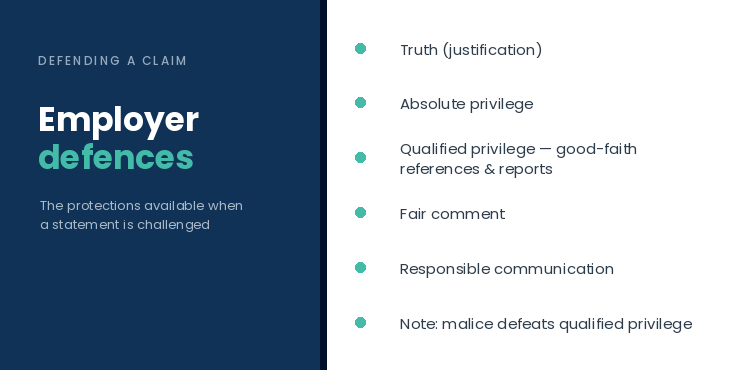
Employers are not defenceless. The major defences are truth (justification), absolute privilege, qualified privilege, fair comment, and responsible communication. Qualified privilege is the one that does the heavy lifting in employment cases: communications made in good faith by someone with a duty or interest to make them, to someone with a corresponding interest in receiving them, are protected.
A reference given honestly to a prospective employer, or a candid internal report to HR about misconduct, will usually attract qualified privilege. But that protection evaporates the moment malice enters the picture, or the statement travels wider than the legitimate interest requires. A manager who uses a reference call to settle a personal score loses the shield.
This is the territory where an Ontario employment lawyer spends real time, because workplace defamation rarely arrives alone. It tends to ride alongside a wrongful or constructive dismissal claim, a workplace harassment complaint, or a poisoned-reference dispute after a separation. The reputational harm and the employment harm are usually two faces of the same underlying conflict.
Relevant Articles:
The criminal dimension: still on the books in Canada
Here is what surprises most people. Canada is one of the relatively few common-law countries that retains criminal defamation, formally called "defamatory libel," in sections 297 through 317 of the Criminal Code. The Code defines defamatory libel as matter published, without lawful justification or excuse, that is likely to injure the reputation of a person by exposing them to hatred, contempt or ridicule, or that is designed to insult.
The penalties are not trivial on paper. Publishing a defamatory libel can carry up to two years' imprisonment, and publishing one the accused knows to be false can carry up to five. The Supreme Court of Canada upheld the constitutionality of the defamatory libel provisions in R v Lucas, [1998] 1 SCR 439, in 1998, so they remain live law rather than a dead letter.
In practice, charges are extraordinarily rare, and almost never arise from ordinary workplace friction.

Criminal defamatory libel tends to surface only in the most extreme cases – sustained, malicious campaigns to destroy someone, often involving knowingly false and deeply damaging publications. A heated exit conversation or a careless reference will not get anyone arrested. But the existence of the offence is a useful reminder that reputation is protected by more than one body of law, and that conduct which begins as a workplace grievance can, at the extreme end, shade into criminal territory – particularly when it migrates online into sustained harassment or fabricated allegations.
How other countries the same problem
Australia, as a Commonwealth comparison, offers a striking contrast, and it is one worth drawing because the two systems have diverged in an interesting way. Australia abolished common-law criminal defamation and replaced it with statutory criminal defamation offences that survive in most states and territories – for example, section 529 of the Crimes Act 1900 (NSW), which makes it an offence to publish matter defamatory of another living person, knowing it to be false or without regard to whether it is true or false, with intent to cause serious harm. The maximum penalty in New South Wales is three years' imprisonment.
As with Canada, prosecutions are uncommon, and the civil regime under the uniform Defamation Acts does the vast bulk of the work. But the criminal provisions are not ornamental. According to Sydney-based criminal defence lawyers Kingston Fox, the situations where workplace and personal disputes tip into genuine criminal exposure in New South Wales increasingly involve online conduct – where a campaign of false and damaging publications can engage not only criminal defamation but adjacent offences such as using a carriage service to menace or harass, and other cybercrime provisions. That intersection between reputation and digital conduct is where Australian criminal practitioners now see the sharpest growth, and it mirrors the Canadian pattern: the old offence rarely bites, but its modern online cousins increasingly do.
What this means in practice
For employers, the lesson is the same on both sides of the Pacific. The realistic legal risk in almost every workplace reputation dispute is civil, not criminal, and it is entirely manageable with disciplined communication. Keep explanations for terminations factual and confined to those who genuinely need them. Train managers to understand that qualified privilege protects honest, measured communication and nothing beyond it. Treat references as a legal document, not a casual favour. The criminal provisions exist, but they are reserved for conduct so egregious that no well-run organisation should ever come close.
For employees, the practical takeaway is that a damaged reputation arising out of work is usually actionable, and the door is wider than people assume – falsity is presumed, and a single email to the wrong recipients can be enough. If a separation has been accompanied by statements that have followed you into the job market, that is a civil defamation issue layered on top of an employment law one, and the two are best assessed together. HTW Law also handles defamation claims directly, which is precisely why reputation and employment so often land on the same desk.
The bottom line: workplace defamation is overwhelmingly a civil problem, in Canada as in Australia. But both countries keep a criminal version on the statute books, dormant most of the time and decidedly awake in the rare cases of deliberate, malicious destruction of reputation – increasingly, in the cases that play out online.
Whether you are an employee whose dignity has been compromised, or an employer requiring sophisticated defense strategies against tactical claims and massive civil liability, navigating this legal minefield requires top-tier representation.
Don't fight in the dark. Contact the experienced employment lawyers at HTW Law today to protect your rights, your reputation, and your bottom line.
With the right legal support, employees can ensure their employment law rights are protected; employers can avoid lawsuits. |  |
Relevant Blog Posts:
 | As an employee, you don't have to fight the battle alone. Speaking with an employment lawyer who is familiar with the laws and regulations regarding defamation, discrimination, harassment, wrongful termination, and constructive dismissal, employment contracts and employment law in general will go a long way. If you are in doubt, it's essential that you reach out for help as soon as possible right away. |
Click here to contact HTW Law - Employment Lawyer for assistance and legal consultation.


Author bio:
Tony T. isn't a lawyer, but he translates their legal jargon into plain English so you don't have to. He holds zero legal authority, but maintains very strong opinions on office microwave etiquette. Tony’s job is to sit at his keyboard and make sure you know your rights. He is a firm believer that "reply all" should require two-factor authentication.


